The man in the grey overcoat looks over his shoulder. The bridge is empty. No witnesses. He leans over the snow-flecked railing. His eyes widen. The icy black water swells ominously below, beckoning him to come closer, closer… He leans over—

It’s a Wonderful Life is widely regarded as the best Christmas movie ever. Yes, better than A Muppet Christmas Carol or even Die Hard. Yet according to contemporary audiences, it wasn’t even the best Christmas movie of 1946. (That “honour” goes to The Miracle on 34th Street.) Despite the film starring Jimmy Stewart, the Tom Hanks of his day, and being directed by Frank Capra, the Spielberg of the his day – it was a financial flop. It was deemed “too dark” by audiences upon its release in December 1946. You know, the same audiences that were totally OK with imprisoning 100,000 Japanese Americans in internment camps for three years before nuking 600,000 of their brethren.

Wow. That got dark fast. Let’s lighten the mood a little.

In fact the film dwindled in obscurity for three decades until a “clerical error” (read: “massive fuck-up”) in 1974 caused its copyright to lapse. Over the next twenty years, hundreds of cash-starved local TV stations broadcast the film a Yuletide filler. They often played it several times over the holidays to boost the Nielsen ratings – and why not, it was free! “It’s in black and white, it’s got Jimmy Stewart – has to be some forgotten classic, right?” Christmastime guaranteed tens of millions of family viewers who’d lap up practically anything. Don’t believe me? Four words: Star Wars Holiday Special (1978).
Well. Let’s see how the cast responded. Carrie Fisher would never sing in public again. Harrison Ford wouldn’t look this stiff and awkward till Kingdom of the Crystal Skull. Hell, George Lucas himself claimed “If I had time and a sledgehammer, I would track down every bootlegged copy of that programme and smash it.” Yes, the same George Lucas who made Attack of the Clones. The same genius who penned the cringe-worthy line: “I don’t like sand. It’s coarse and rough and irritating. And it gets everywhere.”
Anyway. Back to the movie. Jimmy Stewart is a cinema icon for precisely the same reason Tom Hanks is – he excels at playing “the everyman”. George Bailey is that everyman. A small-town man with big dreams. Like any young man worth his salt, he is defined by his ambition. He longs to be free of his banal constraints, free of his claustrophobic little hometown. (“I couldn’t face being cooped up all my life in a shabby little office…”) He vows that the cradle Bedford Falls shall not be his grave: “I’m shakin’ the dust of this crummy little town off my feet and I’m gonna see the world. Italy, Greece, the Parthenon, the Colosseum…” He dreams of creating, of shaping the world around him: “I’m gonna build things. I’m gonna build airfields, I’m gonna build skyscrapers a hundred stories high, I’m gonna build bridges a mile long…” (Fun fact: Jimmy Stewart himself designed an airport for his Princeton architecture thesis in 1932, before resorting to acting in pre-“New Deal” America.) But the best laid plans…
A family tragedy forces George to postpone his world tour and concentrate on domestic matters. The foremost concern is the proposed dissolution of the family business, the Bailey Savings and Loan. For those of you who aren’t financial nerds or history buffs, here’s a q primer: Savings and Loan (S&L) associations were local, non-profit co-operatives that offered competitive interest rates on deposits and fair interest rates on mortgages. They were a lot like Credit Unions – without embarrassing ads featuring Brian O’Driscoll. You might have noticed I use the past tense to describe S&L – and with good reason. A perfect storm of Federal deregulation, spiralling interest rates and inflation caused a lack of investment and led to “creative accounting” (read: “fraud”) to cover it all up. By the 1980s the S&L were utterly discredited. (Pun intended.)

Back to the flick. An emergency board meeting places George Bailey vis-à-vis with our deliciously villainous Mr. Potter. Potter is an archetypal Rockerfeller-style monopolist. He’s a greedy slumlord, squeezing the “discontented lazy rabble” in dingy shacks. He has a stake in every Main Street business – even the bank. Every man, woman and child in Bedford Falls bows and grovels to him – except for George Bailey. Bailey sees the voiceless working class people as exactly that – people. “Is it too much to have them work and pay and live and die in a couple of decent rooms and a bath?” And Bailey fulfils these humble aspirations – at least for a little while.

George Bailey is a hero. No, he doesn’t wear a cape. Or a spandex jumpsuit. Or underwear on the outside of his pants. But he is braver and more selfless than anyone in Bedford Falls. Throughout his life he consistently puts the needs of others ahead of his own. At the age of 12, George risks his life to save his drowning little brother. He ends up half-deaf himself for his troubles. He saves another innocent child, he saves a man’s livelihood. He gives his own college money to his younger brother. He protects the life savings of his community at a huge personal cost. He builds affordable housing, he offers fair mortgages. All the while his take-home pay is a bare $45 a week – a fraction of what he could earn elsewhere. The film’s Christian overtones may seem heavy-handed to some. But Bailey’s Christ-like portrayal is more subtle. Bailey works everyday miracles and brings people back from the brink of death. He too is tempted, betrayed, mocked and seemingly foresaken. He is brought to the point of breaking: to the bridge and the black abyss.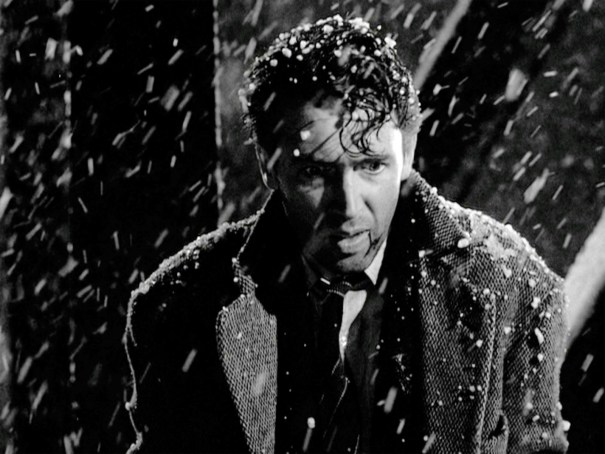
Conventional wisdom dictates that you would never depict a suicide attempt in some family-friendly Christmas movie. “Audiences want to feel warm and happy,” I imagine some executive producer muttering, “They want a treacly romance, cute kids and a big ol’ grumpy villain that everyone can root against.” To its credit, It’s A Wonderful Life offers all these things. Its screwball romance offers the film’s sweetest and jauntiest scenes. Bailey’s own children tread the fine line between blandly well-behaved and gratingly annoying. But life has meaning only because of its transience, by the spectre of death. Only by sinking into the depths of despair can Bailey, and the audience, truly appreciate the joys of everyday life.

My close friend’s former classmate tragically took his own life last year. It came as an utter shock to her and to all his friends. “I don’t understand,” she lamented, “I just don’t understand how things can ever get that bad.” And it’s true, she didn’t understand. She couldn’t. She had never been depressed herself, never considered suicide. True, objectively things may never be “that bad”. But it can definitely feel that way. “Every day, the future looks a little bit darker.” Setback after setback wears you out, wears you down to only a nub of your former self. You feel it’s only further downhill from here. Sometimes it may feel as though there is only one remaining escape from everything, and everyone. One way out.
You probably haven’t heard on Blake Snyder – and with good reason. He’s hack. He wrote such execrable “comedies” and Blank Check and Stop! Or My Mom Will Shoot. An somehow his insipid, formulaic screenplays sold for up to a million bucks a pop. Where’s the justice? Anyway, Snyder also wrote Save the Cat, a sublime guide detailing how anyone could write a screenplay – even himself. Snyder described the end of Act Two, the hero’s lowest ebb, as the “Dark Night of the Soul”. A time of hopelessness. A spiritual crisis. And a quick Google search reveals that its also the name of a poem by a Reformation saint. Its verse fittingly echoes George Bailey’s anguished Christmas Eve walk towards oblivion.
“In the happy night,
In secret, when none saw me,
Nor I beheld aught,
Without light or guide, save that which burned in my heart.”

At this point we reach the film’s fantastical segue. From Dallas to Rugrats, countless TV shows and films have paid homages to this seminal Third Act. Even if you haven’t seen the film, even if you haven’t heard of it, you’ll be familiar with its big “alternate universe” moment. But in case you have spent your entire life under a Martian rock – spoiler alert. Bailey wishes he’d “never been born”. And so he is given “a great gift” – a chance to see what the world would be like without him. He sees first-hand how the lives of everyone in Bedford Falls and beyond would be poorer for his absence. In his own universe, he never did leave Bedford Falls. He never built bridges nor airfields nor skyscrapers. But in a thousand ways, great and small, he tangibly improved the world around him. These hard-hitting revelations stun him. They shock him, terrify him. And they eventually make him appreciate “God’s greatest gift” – life.

Save the Cat has something else to say about storytelling: Everybody grows – except the villain. As we see with George Bailey, the hero grows throughout his journey. He develops a deeper understanding of the world – and of himself. But his plight also changes the lives of all his friends. These secondary characters learn and develop in their own way. In no film is this more explicit than It’s a Wonderful Life. “Each man’s life touches so many other lives.” The only person who doesn’t change is Mr. Potter. Financial worth is all he values in other human beings. And that never changes. Like a gnarled, stunted old tree trunk, Potter never grows. “You’re worth more dead than alive,” he spits out in response to Bailey’s life insurance. He never learns what Bailey learns, what we all learn: the immeasurable value of human life. United with his loving family and caring friends, George Bailey is “the richest man in town”.
As Saint John of the Cross writes in The Dark Night of the Soul:
“I remained, lost in oblivion;
My face I reclined on the Beloved.
All ceased and I abandoned myself,
Leaving my cares forgotten among the lilies.”


 Corzies
Leave a comment